
Showing posts with label cameras. Show all posts
Showing posts with label cameras. Show all posts
Friday, August 19, 2011
Samsung W200 waterproof / rugged 1080p camcorder review


Thursday, July 14, 2011
Sony - Cyber-shot DSC-H70
TAKEN FROM IMAGING RESOURCE
The Sony Cyber-shot DSC-H70 digital camera is a pocket camera with a 10x zoom starting at 25mm and reaching out to 250mm, a great choice as an everywhere camera, or a vacation camera. With a 16.1-megapixel sensor, a Bionz-branded image processor, the Sony H70 should offer good speed and image quality when needed. The Sony H70's lens carries the same Sony G branding as the company's digital SLR lenses, an indication of its confidence in the lens' optical performance.
The Sony H70 has a two step aperture, which varies from f/3.5 to f/5.5 across the zoom range. At wide-angle the alternate aperture is f/8.0, and the lens also includes a built-in neutral density filter. To help combat blur from camera shake, the Sony DSC-H70's lens includes an optical stabilization mechanism that works in concert with a built-in gyro sensor to detect and correct for camera motion. As with certain of Sony's other recent Cyber-shot cameras, the stabilization function works with up to 10x increased power in Movie mode, taking advantage of the more forgiving lower resolution of the movies as compared to still images.
The Sony H70 uses a 3-inch Clear Photo LCD display with a resolution of 230,000 dots, roughly equating to a resolution of 320 x 240 pixels with separate red, green, and blue dots per pixel. A nine-point autofocus system includes face detection capability, and can recognize up to eight faces in a scene. The face detection function can be disabled if desired, and can also be programmed to give priority to either adult or child faces. The AF system can also operate in either center-weighted or spot AF modes, and includes an AF assist illuminator.
As well as still images, the Sony H70 can capture either high-definition 720p (1,280 x 720 pixel) or standard definition VGA (640 x 480 pixel) video at a frame rate of 29.97 frames per second. Movies are saved with MP4 compression, and include monaural audio. The Cyber-shot DSC-H70 also includes a sweep panorama function, which can automatically capture multiple shots by simply sweeping the camera across the scene, and then stitch these in-camera into a single image with an increased field of view. A Self Portrait Timer mode allows the photographer to get in the picture before the shutter is automatically triggered, and a Smile Shutter function ensures everybody is smiling before the shutter fires.
The Sony H70 stores images on Secure Digital, SDHC or the latest SDXC types. The Sony H70 is also compatible with Sony's own proprietary Memory Stick PRO Duo cards. Power comes from a Sony InfoLithium NP-BG1 rechargeable battery. Connectivity options include both USB data, as well as standard definition composite and high definition component video outputs.
The product bundle includes Sony's Picture Motion Browser v5.3 and Picture Motion Browser Portable applications. Pricing for the Sony DSC-H70 is around US$230, and the camera is available in black, silver, blue, or red versions beginning March 2011.

The Sony Cyber-shot DSC-H70 digital camera is a pocket camera with a 10x zoom starting at 25mm and reaching out to 250mm, a great choice as an everywhere camera, or a vacation camera. With a 16.1-megapixel sensor, a Bionz-branded image processor, the Sony H70 should offer good speed and image quality when needed. The Sony H70's lens carries the same Sony G branding as the company's digital SLR lenses, an indication of its confidence in the lens' optical performance.
The Sony H70 has a two step aperture, which varies from f/3.5 to f/5.5 across the zoom range. At wide-angle the alternate aperture is f/8.0, and the lens also includes a built-in neutral density filter. To help combat blur from camera shake, the Sony DSC-H70's lens includes an optical stabilization mechanism that works in concert with a built-in gyro sensor to detect and correct for camera motion. As with certain of Sony's other recent Cyber-shot cameras, the stabilization function works with up to 10x increased power in Movie mode, taking advantage of the more forgiving lower resolution of the movies as compared to still images.
The Sony H70 uses a 3-inch Clear Photo LCD display with a resolution of 230,000 dots, roughly equating to a resolution of 320 x 240 pixels with separate red, green, and blue dots per pixel. A nine-point autofocus system includes face detection capability, and can recognize up to eight faces in a scene. The face detection function can be disabled if desired, and can also be programmed to give priority to either adult or child faces. The AF system can also operate in either center-weighted or spot AF modes, and includes an AF assist illuminator.
As well as still images, the Sony H70 can capture either high-definition 720p (1,280 x 720 pixel) or standard definition VGA (640 x 480 pixel) video at a frame rate of 29.97 frames per second. Movies are saved with MP4 compression, and include monaural audio. The Cyber-shot DSC-H70 also includes a sweep panorama function, which can automatically capture multiple shots by simply sweeping the camera across the scene, and then stitch these in-camera into a single image with an increased field of view. A Self Portrait Timer mode allows the photographer to get in the picture before the shutter is automatically triggered, and a Smile Shutter function ensures everybody is smiling before the shutter fires.
The Sony H70 stores images on Secure Digital, SDHC or the latest SDXC types. The Sony H70 is also compatible with Sony's own proprietary Memory Stick PRO Duo cards. Power comes from a Sony InfoLithium NP-BG1 rechargeable battery. Connectivity options include both USB data, as well as standard definition composite and high definition component video outputs.
The product bundle includes Sony's Picture Motion Browser v5.3 and Picture Motion Browser Portable applications. Pricing for the Sony DSC-H70 is around US$230, and the camera is available in black, silver, blue, or red versions beginning March 2011.
Sony Cyber-shot DSC-H70 User Report
by Greg Scoblete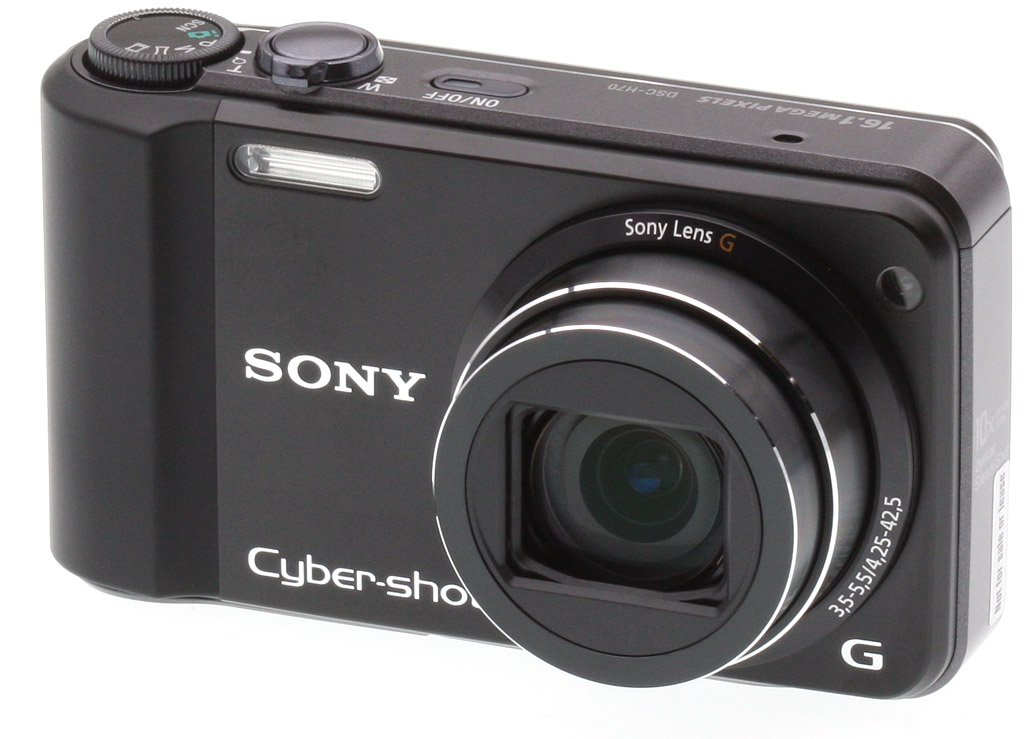
TAKEN FROM IMAGING RESOURCE
Sunday, July 10, 2011
Sony NEX-C3 Hands-on Preview
Sony NEX-C3 Hands-on PreviewJune 2011 |  Preview based on a pre-production NEX-C3 with firmware 01 The NEX-C3 is the start of Sony's second generation of mirrorless cameras, following the introduction of the 14MP NEX-3 and NEX-5. If these first two models showed how committed Sony is to offering APS-C capabilities in a compact form factor, the point is underlined by the arrival of the still-smaller C3. Sony is one of the companies with most to gain a widespread adoption of mirrorless cameras. The inroads it made into the conventional DSLR market were pretty modest compared to its ambition, and there's clearly an opportunity to combine its in-house expertise from its Cyber-Shot compacts with the interchangeable lens know-how it gained when it bought Konica Minolta, back in 2006. The NEX-C3, even more than its predecessors, underlines the company's desire to offer this blend of compact camera convenience with large sensor image quality. Despite its larger sensor, the C3 challenges the smallest Micro Four Thirds models in terms of size, with only its kit zoom limiting its compactness. The big news, beyond the NEX-C3's reduced size, is the inclusion of a 16MP sensor. This isn't exactly the same sensor used to such great effect in the Sony A55 (amongst others), but a re-engineered version designed to offer improved power consumption, with the promise of lower image noise and improved temperature characteristics as a result. The inclusion of what's likely to be a more capable sensor isn't a feat to be belittled but, beyond this, the changes are minimal. There are changes to the user interface - the addition of a distinctly Olympus-style outcome-orientated simple shooting mode is the most obvious revision. There's a touch more user customization available to shooters in the more user-controlled modes and, almost inevitably, a selection of fun image processing filters (another feature it's hard not to associate with Olympus). Sony has previously spoken of expanding the NEX range in two directions - in an easy-to-use direction for point-and-shoot upgraders and towards offering greater manual control for enthusiasts - and it doesn't take extensive analysis to work out which of these the C3 is part of. Just as Panasonic has decided to shrink and simplify its G and GF-series cameras, Sony is clearly trying to attract customers who want DSLR quality but wouldn't consider lugging a big black lump of camera around, and who (quite reasonably) are more interested in taking good pictures than learning what f-numbers mean.
Sony NEX-C3 specification highlights
| ||||||


Thursday, July 7, 2011
Sony HDR-PJ50 Camcorder Sports a built-in Projector

Sony’s HDR-PJ50 handycam has stolen a play out of Nikon’s playbook. To be more specific, it sports a built-in projector directly into the camcorders 3-inch fold out LCD screen, which we first saw a few years ago in Nikon’s Coolpix S1000pj. Given the rather small, and probably underpowered nature of the built-in projector, you’ll need an almost pitch black room to achieve a decent contrast ratio, especially if you max out its display size of 60-inches. Under the hood it has a sensor that can capture full HD video and 7.1 megapixel photos. There is also a 12x optical zoom, 220GB hard drive, the ability to capture 5.1-channel surround sound and a Memory Stick slot for expanded storage.
Surprisingly, the HDR-PJ50 is already on sale in Asia for $1,350.
Taken from gadgetreview.com
Tuesday, July 5, 2011
Pentax Q Hands-on Preview
Preview based on a pre-production Pentax Q running firmware 1.0
 To make clear what the rather opaque 1/2.3" figure actually means, it equates to a surface area of around 28mm2. This is around 1/8th the size of the sensor used in Micro Four Thirds cameras and 1/13th the size of the the APS-C format sensor in Sony's NEX. The advantage of this is that the lenses for the Q mount can be made a lot smaller than those for other systems, but the downside is that the image quality is more likely to resemble that of a compact camera than a DSLR.
The Pentax Q is the smallest interchangeable lens camera on the market. And, just like the company's famously diminutive Auto 110 SLR from the late 70's, it achieves this by embracing a smaller format than its peers. Being built around a 1/2.3" sensor, the Q is a fraction of the size of even the smallest existing mirrorless cameras and is the first really pocketable model (though the protruding lens still means that'll have to be the pocket of your jacket, rather than your shirt or trousers).

Olympus PEN E-P3 Preview

Olympus E-P3 key specifications:
- Updated 12MP Live MOS sensor
- 120 Hz 'Fast AF' focus system
- Built-in flash
- Built-in autofocus illuminator light
- Touch-sensitive VGA-equivalent 614,000 dot OLED screen (3:2 aspect ratio)
- Dual-core TruePic VI processor
- 1080i60 movies in AVCHD format
- Shadow tone adjustment control
- Revised and expanded Art Filter mode (with quick preview option)
- Interchangeable hand grips
- In-body image stabilisation (works with all lenses)


TAKEN FROM dpreview.com
READ FULL REVIEW HERE
Subscribe to:
Posts (Atom)